
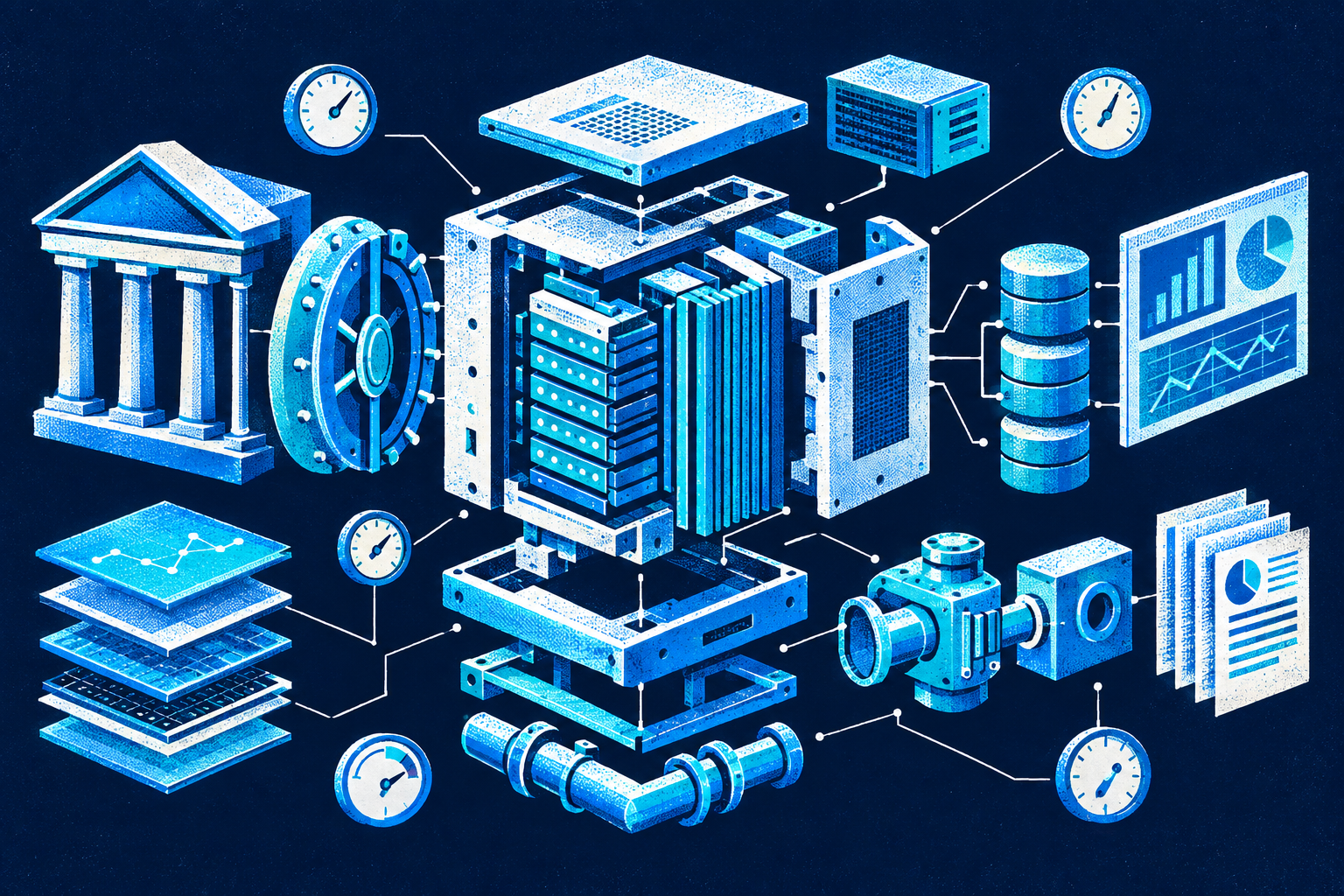
Every major financial services firm has an AI roadmap for 2026. Most of them are sequenced wrong — and the order of operations will determine who actually deploys versus who spends another year in pilot purgatory.
Every major industry report right now is saying the same thing: 2026 is the year financial services moves from AI experimentation to enterprise-wide deployment. Hyper-personalized banking. Agentic automation. Real-time fraud detection that actually learns. The opportunity is real.
So is the failure mode.
What these reports don't say — because they're written for executives at institutions with transformation offices and dedicated AI governance teams — is that the path from "enterprise-wide deployment" to actual workflow integration has a sequencing problem baked into it. And for mid-market financial institutions, that sequencing problem is the whole game.
Here's what I keep seeing in the field: institutions buy the capability, stand up the pilot, get promising results, and then stall. Not because the AI didn't work. Because the organization around it wasn't built to receive it.
The fraud detection model flags anomalies in real time. Great. Who reviews the flagged transactions? What's the escalation path? What happens when the model flags a legitimate business customer and the relationship manager finds out through the customer, not through your system? What does your examiner see when they pull the audit trail?
These aren't technology questions. They're operations and compliance questions. And they have to be answered *before* you scale, not after.
The sequencing problem is this: most institutions are building AI capability on top of operational infrastructure that was never designed to support it. They're adding intelligent automation to workflows that were designed for manual review. They're deploying adaptive systems into change management processes that move at a quarterly cadence. The AI is ready. The operating model isn't.
Take AML and KYC — two of the highest-priority AI deployment areas for 2026. The pitch is compelling: move from rule-based screening to adaptive, real-time intelligence. Better accuracy, faster onboarding, stronger risk management. All true.
But here's what the trend reports skip: when your AI-enhanced KYC system flags a case differently than your legacy system would have, someone has to explain that to a regulator. Your compliance team needs to understand *why* the model made the call it made. Your audit trail needs to reflect a reviewable decision process, not just an output.
If you haven't done the workflow work upstream — documenting the decision logic, building the human review checkpoints, training the compliance staff who will be asked to defend those decisions — your AI deployment is a liability, not an asset. You've made your system more intelligent and your audit posture more fragile at the same time.
This is not a reason to avoid the deployment. It's a reason to sequence it correctly.
Before you scale any AI workflow in a regulated financial environment, you need answers to four operational questions:
1. Who owns the output? AI systems produce outputs. Someone in your organization needs to be accountable for those outputs — not just notified of them. Define that role before you deploy.
2. What's the review path? Automation doesn't mean no human in the loop. It means a smarter human in the loop, at the right point in the process. Map the escalation path before the model goes live.
3. What does the examiner see? Regulators don't evaluate your AI. They evaluate your controls. Build the audit trail and the explainability layer as part of the deployment, not as a retrofit.
4. What breaks first? Every AI workflow has a failure mode. Model drift, data quality degradation, edge cases the training set didn't cover. Know your failure mode before you scale. Build the detection mechanism before you need it.
If you're a mid-market financial institution planning an AI deployment in 2026, the most important question you can ask right now is not "what AI should we buy?" It's "what does our operating model need to look like before this AI is safe to scale?"
The institutions that win in 2026 won't be the ones with the most sophisticated models. They'll be the ones that did the unglamorous work of making their operations ready to receive them.
Sequence that correctly, and the AI delivers. Get it backwards, and you've built a faster way to generate compliance problems.
The technology is ready. The question is whether you are.
Dealing with a similar challenge?
We work with mid-market companies in regulated industries to build AI workflows that actually hold up.
Let's TalkSean Cummings
Founder of Laminar Consulting Services. Specializes in AI workflow automation for regulated industries — medical device, financial services, and complex logistics operations.