
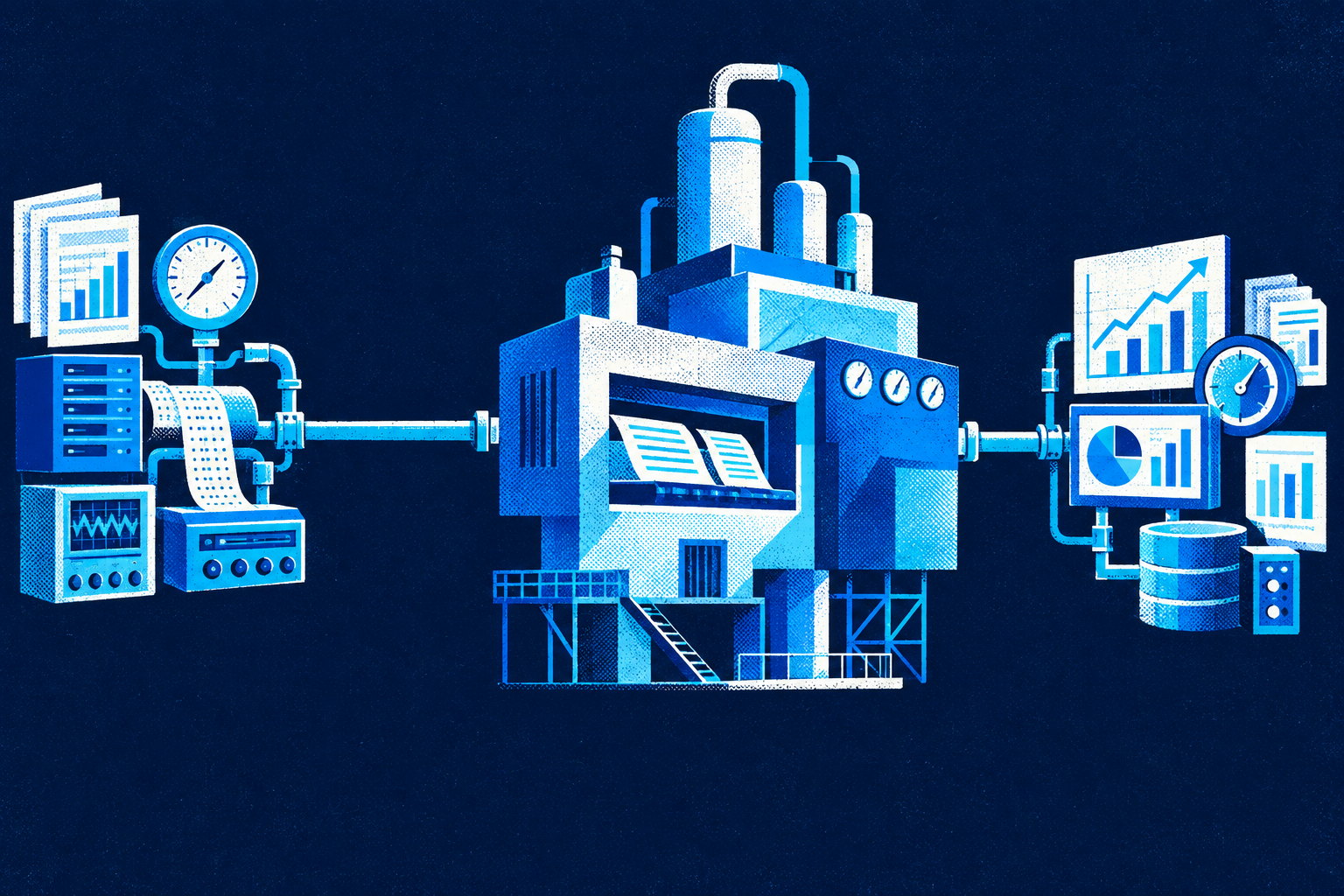
Gartner and McKinsey say late AI adopters will lose ground. That's probably true. What they don't say is that 'adopting AI' and 'capturing productivity gains' are two completely different problems.
Every few months, another wave of AI productivity data hits the business press. Gartner says late adopters will fall behind. McKinsey says AI-driven operations are pulling ahead. The numbers are real. The logic holds.
But here's what the reports don't tell you: productivity gains from AI don't accrue evenly, and in regulated industries, they often don't accrue at all — not because the tools don't work, but because the operating environment punishes the shortcuts that made the gains possible elsewhere.
If you run operations in medical device, financial services, manufacturing, or any other regulated space, reading those benchmarks without that caveat is dangerous.
The bulk of AI productivity data — especially the headline numbers — comes from sales automation, customer support triage, and finance back-office work. Those environments share a few key characteristics: relatively clean data, low compliance overhead, and the freedom to iterate fast when something goes wrong.
Your environment probably has none of those things.
You have data sitting in systems that haven't talked to each other in fifteen years. You have change control processes that make a two-week software sprint into a four-month validation cycle. You have compliance teams who are not obstructionists — they're doing their jobs — but whose jobs add real time and cost to every workflow change you try to make.
When the benchmark study says a company cut invoice processing time by 60% with AI, they're not lying. They're just not describing your situation.
Most mid-market operators in regulated industries are not behind because they haven't bought AI tools. Many of them have. The gap is that they bought tools into environments that weren't ready to extract value from them.
Readiness isn't a feeling. It's a set of concrete preconditions:
Data quality at the point of use. AI doesn't fix upstream data problems. It amplifies them. If your production records, customer data, or financial inputs are inconsistent, incomplete, or siloed, an AI workflow will surface that faster than any audit ever did.
Process definition before automation. You cannot automate a process that nobody has fully mapped. This sounds obvious. It is almost universally ignored. Teams automate the workflow they think exists, not the one that actually runs.
Accountability structure post-go-live. The productivity gain is not in the implementation. It's in the sustained operation. Who owns the model's outputs? Who catches drift? Who updates the logic when the regulation changes? If you don't have answers to those questions before launch, you will lose the gains within six months.
Gartner's warning about late adopters is worth taking seriously, but the threat isn't binary. You don't fall off a cliff the day you decide not to buy a new AI platform. The erosion is slower and harder to see.
You start losing on speed. Competitors who've built functioning AI workflows are processing quotes, surfacing risks, and flagging exceptions faster than your team can manually review them. The gap compounds.
You start losing on cost structure. Not dramatically, not overnight — but quarter by quarter, the efficiency differential shows up in margins.
And eventually, you lose on talent. The people who know how to operate AI-augmented workflows don't want to work in environments that are still fully manual. This one takes longer to show up, but it's real.
If you're a mid-market operator in a regulated industry reading the productivity reports and feeling pressure to move faster, here's the advice I'd give you:
Don't start with the tool. Start with the process you're trying to improve. Map it fully, including the workarounds nobody put in the SOP. Find out where the actual bottlenecks are, not where people assume they are.
Fix your data inputs before you automate anything. One quarter of data cleanup work will return more on your AI investment than three quarters of tool implementation.
Define ownership before go-live. Not just technical ownership — operational ownership. Who is accountable for the output quality? That person needs to be named before you flip the switch, not after something goes wrong.
Treat compliance as a design constraint, not an obstacle. Your regulatory requirements aren't going away. Build workflows that satisfy them from the start. Retrofitting compliance onto an AI workflow is expensive, slow, and usually incomplete.
The productivity gains are available. But they're not waiting for you at the end of a software purchase. They're waiting for you at the end of a disciplined implementation process — one that accounts for the environment you actually operate in, not the one the benchmark study assumed.
Dealing with a similar challenge?
We work with mid-market companies in regulated industries to build AI workflows that actually hold up.
Let's TalkSean Cummings
Founder of Laminar Consulting Services. Specializes in AI workflow automation for regulated industries — medical device, financial services, and complex logistics operations.