
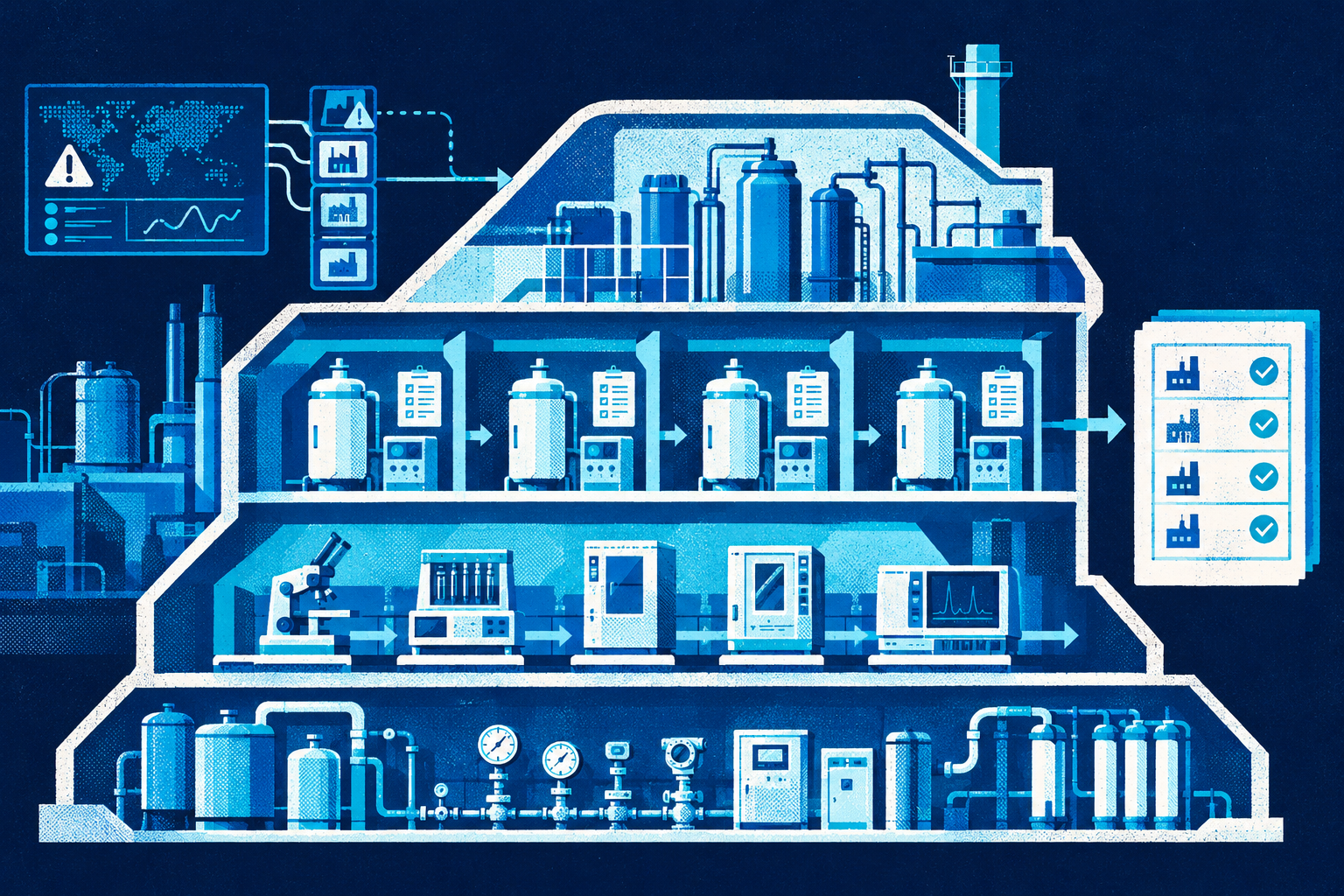
AI tools can now flag supply disruptions early and propose replacement suppliers. In regulated manufacturing, each of those proposals starts a qualification process, and the systems need to be built around that fact.
MarketJoy's recent overview of AI in manufacturing argues that the technology has moved out of experimental trials and into routine work across planning, purchasing, logistics, engineering and delivery. The same piece names supply chain disruption as one of the largest challenges manufacturers face in 2026. It cites rising transport costs, political tensions, a shortage of suppliers and new trade laws. Its answer is that AI gives companies more transparency and better prediction across the supply chain. For a manufacturer that answers to the FDA, a food safety auditor or a customer's quality team, I think that answer covers only the first half of the problem.
Seeing a disruption earlier is valuable. In a regulated plant, the slow and expensive part of responding comes after the disruption is spotted, when someone has to qualify whatever will replace the affected supplier or material. If AI tools start recommending sourcing changes faster than quality teams can evaluate them, the result is a longer queue in front of the quality department.
In medical device manufacturing, ISO 13485 clause 7.4 requires a company to set criteria for evaluating and selecting suppliers based on their ability to provide product that meets requirements. It also requires the company to monitor and re-evaluate those suppliers and keep records of the results. Changing the supplier of a component can also trigger the company's change control process and verification testing. Depending on the part, it can also require an assessment of whether the change affects the device's regulatory submission. None of that work can start until someone decides the alternative is worth pursuing.
Food manufacturers carry a similar obligation. A new ingredient source has to be approved against specifications and allergen controls, and many plants also have supplier approval requirements under FDA's preventive controls rule for human food. Manufacturers that sell into these industries often inherit comparable obligations through customer quality agreements that require notice before a supplier or process change.
In a regulated plant, then, a sourcing recommendation is the first step of a qualification project. If the tool proposing it does not know which suppliers are already approved for which parts, it will surface options that look cheaper and cannot be used. Purchasing staff will then learn to ignore it, which wastes whatever value the early warning had.
The practical fix is to treat qualification status as a hard constraint on what any planning or sourcing tool is allowed to recommend. A supplier already approved for a given part can be proposed as a substitute that purchasing can act on. A supplier that is not approved should appear as a request for quality to begin qualification, along with a realistic estimate of how long that will take. Keeping these two categories separate is what lets buyers trust the recommendations they see.
This requires the approved supplier list to exist in a form software can read. If that list lives in a spreadsheet maintained by one person in quality, separate from the ERP, the first project is moving it somewhere the planning system can check. When Laminar replaced Ventura Foods' legacy RPG mainframe and manual approvals for new product development, the web workflow application included logic for choosing the manufacturing site across U.S., EU and Mexico facilities. Any system that makes a choice like that has to be given its criteria explicitly. An AI tool proposing a new supplier is in the same position, because it can only respect constraints that are written down where it can apply them.
The recommendation itself should also leave a record. When an auditor asks why a component changed suppliers, the company should be able to show what the tool proposed, what data it was working from, and who accepted or rejected the proposal and why.
The more useful role for better prediction in a regulated plant is buying lead time. A tool might flag that a supplier is exposed to a new trade rule or a jump in transport costs months before deliveries are affected. That window is when quality can qualify a second source at a normal pace. For critical components with a single approved supplier, I think this is the strongest argument for these tools.
There is real friction here. Qualifying a supplier you may never use costs money and quality engineering time, and mid-market quality departments are seldom staffed for speculative work. Purchasing is often measured on unit cost while quality absorbs the cost of qualification, so someone with authority over both has to decide which components justify a pre-qualified alternate. A risk ranking from an AI tool can inform that decision, but the people who own the budget and the quality system have to make it.
Dealing with a similar challenge?
We work with mid-market companies in regulated industries to build AI workflows that actually hold up.
Let's TalkSean Cummings
Founder of Laminar Consulting Services. Specializes in AI workflow automation for regulated industries — medical device, financial services, and complex logistics operations.