AI GovernanceRegulated IndustriesCompliance

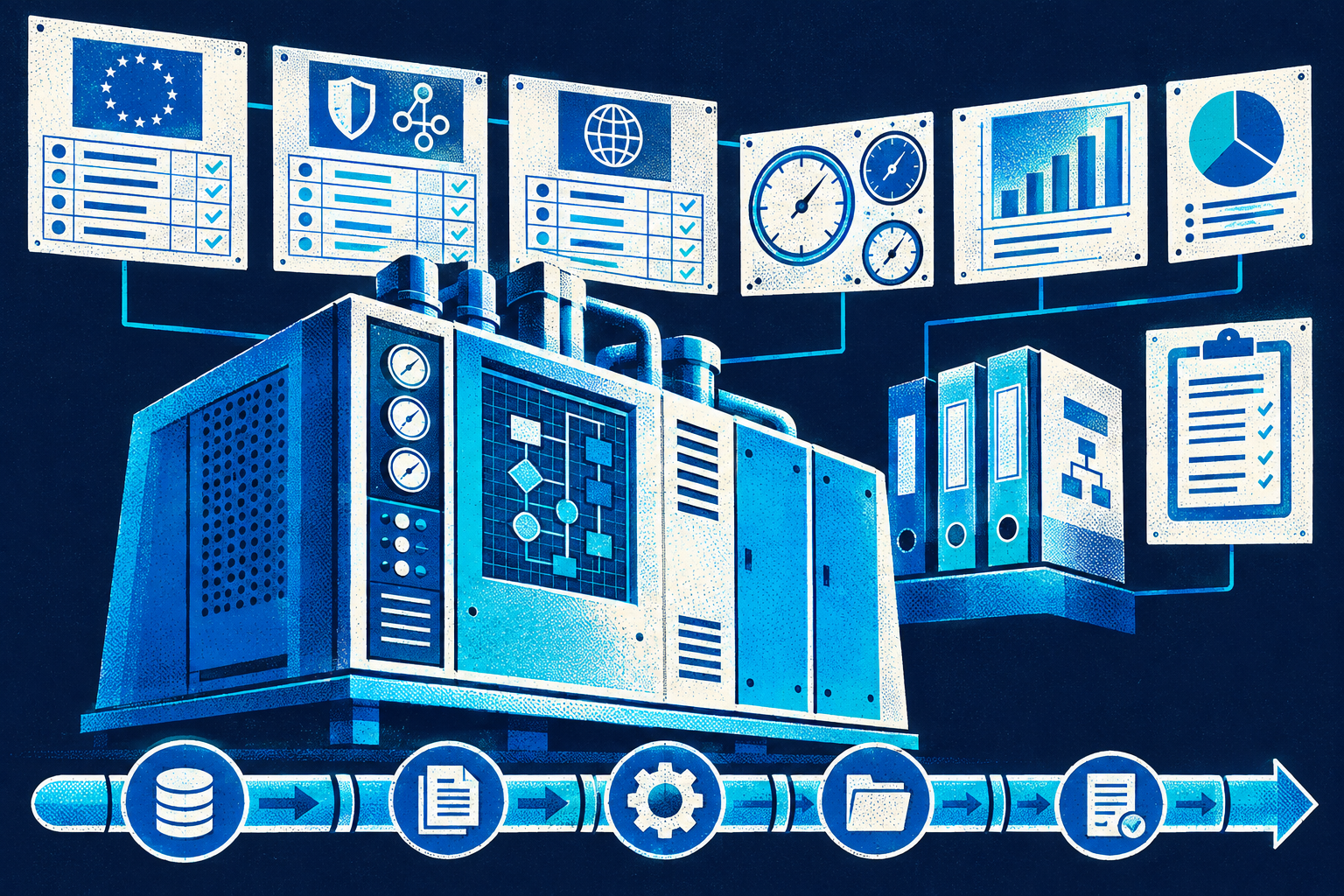
AI governance tools now come with tables mapping their features to the EU AI Act, NIST AI RMF and ISO/IEC 42001. Quality and compliance leaders should read those tables for what they leave to the organization, especially record-keeping and human oversight.
Maxim AI recently published a roundup of AI governance tools for regulatory compliance. Its framing is direct. With the EU AI Act's main obligations becoming applicable on 2 August 2026, the NIST AI Risk Management Framework maturing, and ISO/IEC 42001 establishing a certifiable management standard, platform teams need concrete controls that auditors and regulators can inspect. The article maps a tool stack to specific obligations, including AI Act Article 9 on risk management, Article 12 on record-keeping and Article 14 on human oversight, and to all four NIST functions. Tables like this will reach quality and compliance leaders, often attached to a purchase request from IT. They deserve a careful read, because a mapping shows where a feature touches an obligation, and the rest of each obligation stays with your organization.
The Maxim piece pairs each NIST function with a mechanism. Govern is handled through a policy layer, Map through traceability metadata, Measure through OTLP and Prometheus, and Manage through guardrails and incident response workflows. For readers outside engineering, OTLP and Prometheus are standard ways of collecting operational telemetry and performance metrics from software. That data is useful. It shows how often a model was called, what went in, what came out, and when a guardrail fired. It is also written for engineers and stored where engineers work.
Each obligation in a mapping has a technical portion and an organizational portion. Record-keeping is a good example. A tool can log every prompt and response an AI agent produces. Someone in your company still has to decide which of those logs is the record of a business decision, how long it is retained, and how a compliance analyst retrieves it for an examiner without asking an engineer to run a query. Human oversight follows the same pattern. A tool can route an output to a review queue and record that someone clicked approve. It cannot establish that the reviewer was trained on the criteria, had authority to reject the output, and had enough time per item to use judgment. Your SOPs, training records and staffing plans have to answer those questions.
ISO/IEC 42001 makes this division easiest to see. It is a management system standard, built the same way as ISO 9001, and certification applies to an organization's processes. A medical device quality leader will recognize the arrangement from ISO 13485. Your document control software supports the QMS, and the auditor still audits the QMS.
Mid-market companies rarely deploy AI as a standalone system. The agents being built now sit inside approval workflows, quality processes and finance close procedures that already have systems of record such as an ERP, a QMS or a document repository. A governance tool adds its own store of logs. If the decision record lives in the workflow system and the AI trace lives in a monitoring platform, someone has to be able to connect the two for a single transaction, and that link has to survive upgrades and retention schedules.
LeaseIQ, the transaction platform we built for Healthpeak Properties, is a useful reference even though it involved no AI. It moved lease approval, legal document review and tenant improvement workflows off email, spreadsheets and phone calls, and it integrated with Documentum. Any regulated workflow has to settle where an approval and its supporting documents live, so that a person asking about a decision can find both. When an AI step is added, its output and trace become part of that evidence. I think they should attach to the transaction record your staff already use, with the governance tool's logs referenced from there.
Legacy systems complicate this. An older on-premise ERP or mainframe application will not emit telemetry in these formats, so the parts of a process that happen outside the AI call will not appear in the governance tool at all. The end-to-end record has to be assembled from the workflow side.
A governance tool is a new system that compliance has to review, and its configuration becomes a set of controls. Policy rules, guardrail thresholds and routing rules for human review all change how a controlled process behaves when someone edits them. In a medical device company those edits belong under change control. In financial services they belong in model risk documentation. If an engineer can adjust a threshold in a dashboard with no record of who approved it, the tool has created an uncontrolled change path into a controlled process.
Scope needs attention early. Articles 9 through 14 of the AI Act set requirements for AI systems the Act classifies as high risk, so whether a particular use is in scope is a question to settle with counsel before buying anything. The NIST AI RMF is voluntary, and its four functions still make a reasonable checklist for companies with no EU exposure.
People are the last piece. Reviewers who are handed a queue they did not help design may rubber-stamp it or work around it. Either outcome leaves you with oversight records that overstate how much oversight took place.
Dealing with a similar challenge?
We work with mid-market companies in regulated industries to build AI workflows that actually hold up.
Let's TalkSean Cummings
Founder of Laminar Consulting Services. Specializes in AI workflow automation for regulated industries — medical device, financial services, and complex logistics operations.