Medical DeviceQuality RecordsAI Agents

Payables platforms are opening their systems to AI agents through APIs and MCP servers. Before an agent touches supplier payments, count your exceptions and write down the rules your AP team actually follows.
Trend Hunter reported on November 1 that Settle, a payables platform serving consumer packaged goods companies, has opened a public API and an MCP server. The same Trend Hunter page groups it with BILL's launch of a full accounts payable automation platform in April and Versapay's expansion of its AI tools beyond cash application in October. Trend Hunter's read is that automated supplier payments, reconciliations and cash forecasts "point to a shift toward AI-managed procurement processes for inventory-heavy businesses." For a controller or operations leader at a mid-market CPG or manufacturing company, the useful question is narrower. Once an agent can reach the system that pays suppliers, what happens to the invoices that don't fit the pattern?
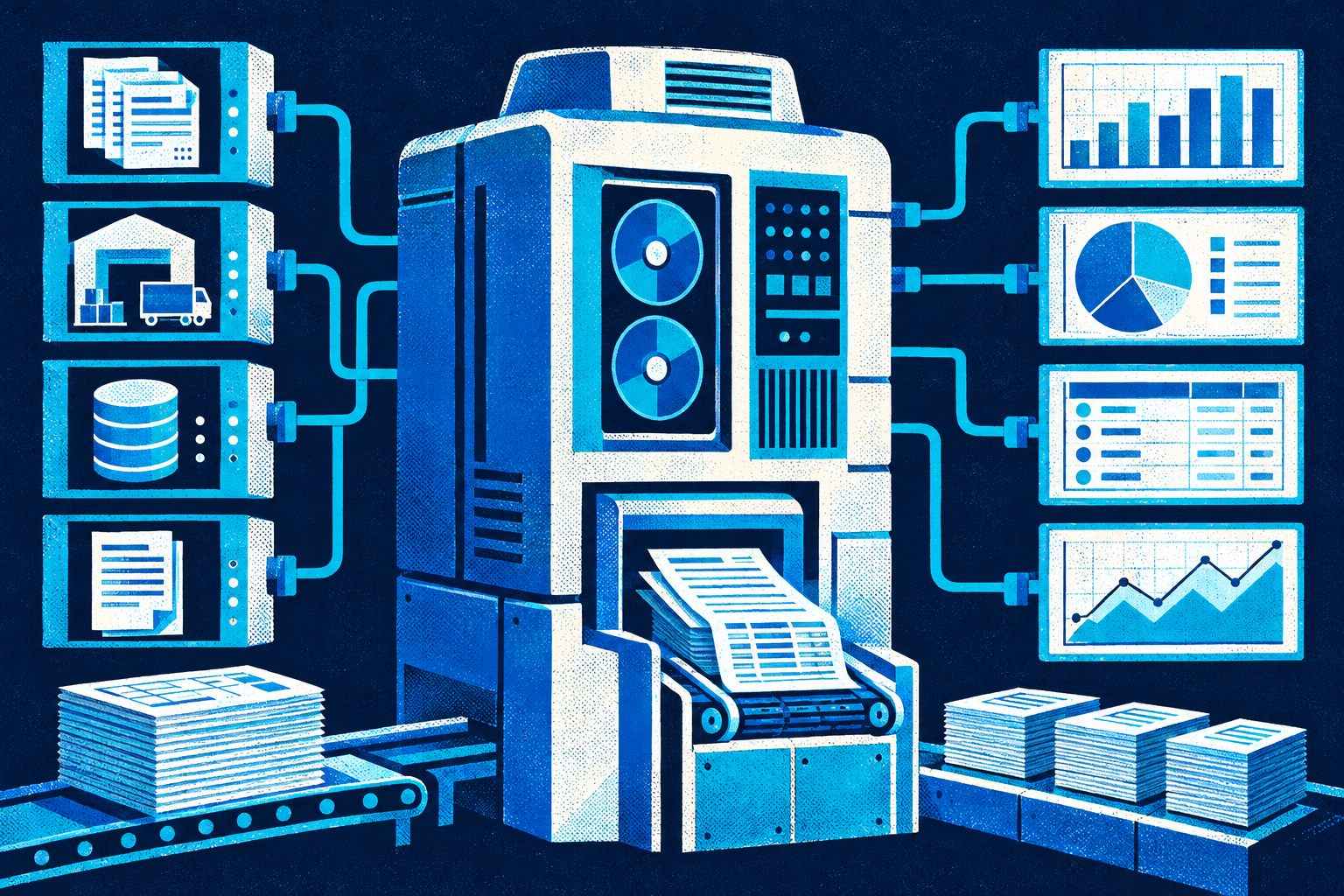
MCP, the Model Context Protocol, is a standard way for an AI assistant or agent to connect to a piece of software, read its data and take the actions it has been permitted to take. A payables platform that offers one makes it much easier for an agent to look up an invoice, check payment status, pull a cash forecast or queue a payment. Trend Hunter describes this as business platforms becoming "interoperable control layers for agents, analytics, and operational systems." That is a real change in plumbing. Connections that used to require a custom integration project can now be set up faster, and sometimes by people outside IT.
The process the payables data comes from stays the same. I think every decade brings a new label for the same work, and the hand-offs underneath stay where they were. A receiving clerk still records what came off the truck, a buyer still has to agree to a co-packer's price change, and someone still decides whether a supplier's new bank account is legitimate. An agent connected through an MCP server inherits all of those hand-offs, along with whatever is missing from them.
A clean invoice that matches its purchase order and receipt is already cheap to process in most AP systems. The cost is in the exceptions: a price that doesn't match the PO, a partial shipment, a freight charge nobody approved, a duplicate invoice with a slightly different number, an invoice with no PO at all. Every company has these. I think very few know how often each type occurs or how long each one takes to clear, and the work tends to sit with one or two experienced people who know which buyer to call.
That gap matters more once an agent is involved, because the agent will do something with every exception it sees. If the rules are written down, it can follow them. If the rules live in someone's head, the agent either routes everything back to a person, which removes most of the benefit, or makes a guess, which is a bad outcome when the action is a payment. Encoding every one-off into the agent's instructions is the opposite trap. It produces a system that is slow to build and expensive to change, and the rare cases still slip through.
When Laminar replaced a legacy mainframe and manual approvals for new product development at Ventura Foods with a web workflow application, the work included logic for choosing the manufacturing site. Software can only make a decision like that once the decision has been stated as rules people agree on. Payables exceptions are the same kind of problem, with cash leaving the company at the end of it.
Payables is one of the most heavily controlled processes in any company. Public companies test these controls under the Sarbanes-Oxley Act of 2002, and many private mid-market companies face similar expectations from their auditors and lenders. Segregation of duties is the core of it: the person who sets up a vendor should not be the person who approves payment to that vendor. An agent given broad access through an MCP server can quietly collapse that separation if its permissions are set for convenience. Whoever connects the agent has to decide which actions it can take on its own, which it can only propose, and how each action is logged so an auditor can see what the agent did and who approved it.
This is where the friction shows up. Internal audit will want to review the design before anything goes live, and that review takes time. The AP team may doubt that an agent will handle the cases they deal with every day, and they are often right to, because they are the ones who know what the exceptions look like. Their knowledge is the main input for the sizing work, so bring them in early.
Dealing with a similar challenge?
We work with mid-market companies in regulated industries to build AI workflows that actually hold up.
Let's TalkSean Cummings
Founder of Laminar Consulting Services. Specializes in AI workflow automation for regulated industries — medical device, financial services, and complex logistics operations.